 |
CMSIS-NN
CMSIS NN Software Library
|

|
|
CMSIS-NN
CMSIS NN Software Library
|
|
This user manual describes the CMSIS NN software library, a collection of efficient neural network kernels developed to maximize the performance and minimize the memory footprint of neural networks on Arm Cortex-M processors.
CMSIS-NN also includes an experimental floating-point extension covering float32 and float16 APIs.
The floating-point API surface is disabled by default and should only be enabled for builds that explicitly require it. This keeps the default code size and API surface aligned with the established integer CMSIS-NN usage model.
The floating-point API style intentionally follows the existing integer CMSIS-NN conventions, including the TensorFlow Lite Micro influenced parameter structure, even though float16 is not part of the TensorFlow Lite Micro API contract.
These floating-point kernels are primarily intended for Cortex-M processors with Helium (MVE) and hardware floating-point support. Scalar reference paths exist for validation and fallback, but they are not the primary deployment target. Floating-point inference should be reserved for specific use cases where integer quantization is not possible or not acceptable, and for neural networks with modest size and runtime requirements.
The floating-point code can also be compiled for Arm A-class processors with float16 support and may benefit from NEON or SVE auto-vectorization. However, this is not an intended deployment target for CMSIS-NN float support, and the resulting performance is expected to be suboptimal compared to libraries designed for that class of processor. For Arm A-class CPUs, prefer optimized inference libraries such as Arm Compute Library or XNNPACK.
The library is divided into a number of functions each covering a specific category:
The figure below illustrates the CMSIS-NN block diagram.
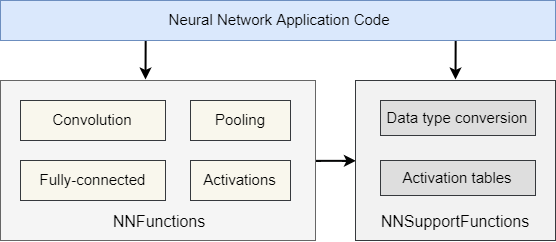
CMSIS-NN targets Cortex-M processors with typically three different implementations for each function. Each implementation targets a different group of processors:
The correct implementation is picked through feature flags and the user does not have to explicit set it.
Notes for floating-point kernels:
float16 support is mainly intended for processors with native float16 arithmetic support.float16, NEON, or SVE can compile generic kernels (non-Helium variants), but this is not the intended deployment target. Prefer Arm Compute Library or XNNPACK for better performance on those processors.CMSIS-NN is actively maintained in the CMSIS-NN GitHub repository and is released as a standalone CMSIS-NN pack in the CMSIS-Pack format.
Also see CMSIS Documentation for an overview of other CMSIS software components, tools and specifications.
The library follows the int8 and int16 quantization specification of TensorFlow Lite for Microcontrollers.
An example image recognition application using TensorFlow Flow Lite for Microcontrollers as an inference engine and CMSIS-NN as the optimized library can be found in the Examples directory.
Feature flag based macros
The macros below are defined in a build system based on feature flags for a chosen processor or architecture input to a compiler. These tie in to the classification in Pre-processor Macros.
For a CMSIS-NN file compiled as armclang -mcpu=cortex-m4 --target=arm-arm-none-eabi -I<CMSIS Core Include> -Ofast -O file.c , the macro ARM_MATH_DSP is enabled as Cortex-M4 has the DSP extension as a feature.
ARM_MATH_DSPARM_MATH_MVEIARM_MATH_MVEFARM_MATH_MVE_FLOAT16User set macros
ARM_MATH_AUTOVECTORIZEARM_NN_ENABLE_F32float32 API and implementation set.ARM_NN_ENABLE_F16float16 API and implementation set.NN_DISABLE_SPECIALIZATIONARM_NN_USE_EXP_LUTARM_NN_USE_EXP_TAYLORARM_NN_USE_EXP_LUT and ARM_NN_USE_EXP_TAYLOR are mutually exclusive.This product confirms to Arm’s inclusive language policy and, to the best of our knowledge, does not contain any non-inclusive language. If you find something that concerns you, email terms.nosp@m.@arm.nosp@m..com.
SPDX-FileCopyrightText: Copyright 2010-2023 Arm Limited and/or its affiliates open-.nosp@m.sour.nosp@m.ce-of.nosp@m.fice.nosp@m.@arm..nosp@m.com